Two soils in one town — river plain and hill till.
Bridgewater is one of the few towns we work where the soil genuinely changes as you drive across it. The Town River plain is sandy and fast-draining; the higher ground toward Scotland and Sprague’s Hill carries heavier stony till that compacts and holds water.
Those two soils fail in opposite directions, and a single blanket program cannot serve both. That is the entire argument for testing before treating — and in this town the test result actually changes what we do, rather than just confirming it.
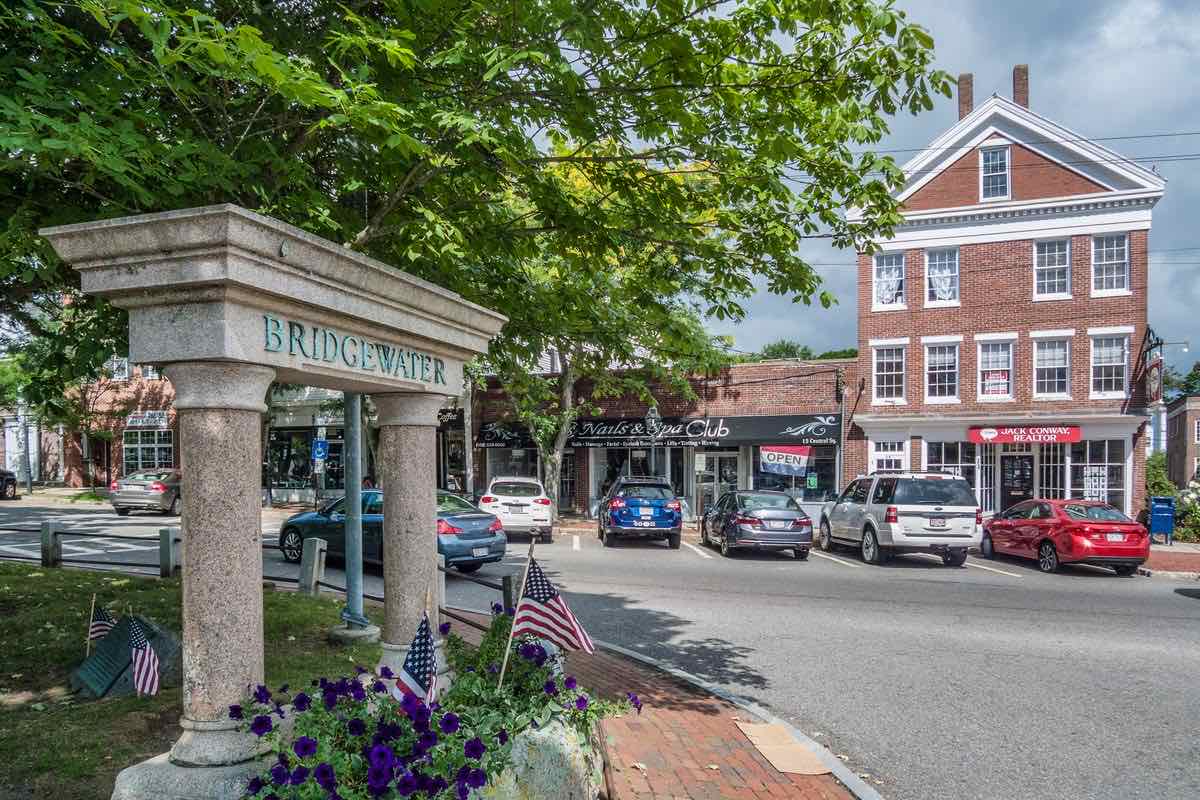
Lawns on the Town River plain and the lower streets sit on outwash sand that drains within hours and holds very little nutrient charge. These are the yards that look excellent in May and tired by late July. They need slow-release feeding so nitrogen is not gone with the first storm, lime to correct the acidity that comes standard with this soil, and enough root depth to reach moisture that the top two inches no longer hold.
Up toward Scotland, Sprague’s Hill and the Titicut side, the soil is stony glacial till with real clay content. It holds water, stays cold late into spring, and compacts under foot and mower traffic until roots simply stop going down. Fertilizer does almost nothing for a lawn in that state. Core aeration is the first move on this ground and often the only one needed to change how the lawn looks.
Central Square and the streets around it carry mature street trees and a century of soil compaction — small yards where aeration and shade-tolerant fescue do disproportionate good. The newer construction off the outer roads has the opposite problem: turf seeded on an inch or two of imported topsoil over compacted subgrade, which looks fine for two years and thins out in the third. Those we rebuild from the soil up rather than feeding harder.
Bridgewater runs a touch later than the coastal towns we serve. Heavy ground holds winter longer, so pushing the first application by the calendar rather than by conditions wastes it. We time pre-emergent to the actual soil-temperature window — around when forsythia breaks here — because crabgrass germinates on soil warmth, not on a date. On the sandy river-plain streets that window arrives a week or so earlier than on the hill.
Sunny sandy sections are strong beetle egg-laying ground in July; prevention belongs in late spring, ahead of the hatch. On watering, the two soils again want different things. Sand wants an inch a week in two deep cycles. Heavy till wants less volume applied more slowly, because water arriving faster than that soil can accept it simply runs off — and a compacted lawn watered harder is still a compacted lawn.
Where we work across town:
Eric knows what he’s doing! We know our lawn is in good hands for its health and curb appeal. He is professional and trust worthy. Give him a call!
Excellent service! Our lawn is so healthy and green! Would highly recommend!
My lawn went from patchy and thin to thick and green. PROTURF knew exactly what it needed.
Get an instant lawn care price or contact us directly. Honest, owner-operated turf care for Bridgewater homeowners.
Serving Southern Massachusetts and nearby Rhode Island — Bristol and Plymouth counties, the South Coast, the South Shore and east to the Cape Cod Canal with a higher level of service. Let’s get your soil healthy today.